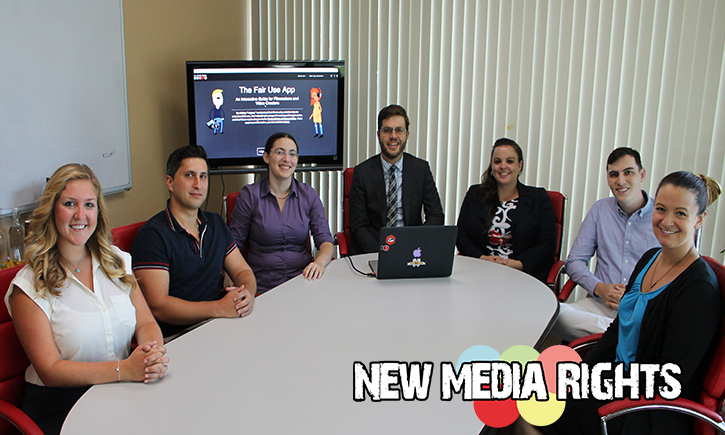
New Media Rights invited to participate in Copyright Office panels considering potential small claims system for copyright law

Description: 

In 2012, the U.S. Copyright Office began a process of considering creating a small claims court or system for small-scale copyright disputes.  This would affect the internet users and independent creators New Media Rights assists significantly.

New Media Rights has been invited by the Copyright Office to participate in hearings taking place November 26 & 27 in Los Angeles on the topic.

Executive Director Art Neill will be participating in panels discussing potential remedies and appeals, constitutional issues, and benchmarks for success of such a system.

A video to our community: Big news about our future!

Description: 

We want to share some big news about the future of New Media Rights and make a few simple requests of you.

Click here to watch the announcement
Click here to watch the video!

We recently finalized a partnership with California Western School of Law.  We’ll still be providing the same quality one-to-one legal services and educational guides for internet users and independent creators, but now, as part of the California Western community, we’ll be able to expand what we do more than ever before.

We’re really excited to be part of the California Western community. The broader internet community will benefit from the increased availability of free and reduced fee legal services, and Cal Western Students will get real-world experience in internet and media law.

We are still completely independently funded, so please support us in starting this partnership off on the right foot

Click here to donate now!

Join New Media Rights in signing the Declaration of Internet Freedom to uphold basic rights in the digital world

Description: 

New Media RIghts has joined a broad, international coalition of civil society groups calling on elected officials to sign the new Declaration of Internet Freedom and uphold basic rights in the digital world.

We encourage you to read and sign the Declaration, and encourage your elected officials to sign it as well.


How mobile apps track and share your location and other personal information

Description: 

You are being tracked. The tracking device is your smartphone. And the tracker? Apple and Google. And your cellphone carrier. And software companies. And countless other third parties. And shopping malls. Oh, and also potentially law enforcement agencies.

Just what, exactly, are these groups tracking? And why? Read on to find out.

Guide for defendants in mass copyright lawsuits (Bit Torrent Filesharing cases)

Description: 

You may be a defendant, or may know a defendant involved in one of the “BitTorrent filesharing lawsuits.” These suits are also sometimes referred to as “Mass copyright lawsuits” because for the first time, hundreds and sometimes thousands of individuals like yourself have been implicated in lawsuits alleging “copyright infringement.” Indeed, as of September 2011, there are over 200,000 individuals involved in such lawsuits.

New Media Rights has drafted the guide below to provide you with basic, practical information regarding these lawsuits.
 

September Newsletter: Success stories, challenging AT&T, and Blogworld 2011

Description: 

Our September newsletter brings news of success stories fighting DMCA abuse, a grant awarded by the California Consumer Protection Foundation, and our continuing efforts to stop the AT&T-Tmobile merger. 

You can also catch us in person at Media Law in the Digital Age in October, a conference coproduced by Harvard Berkman Center's Digital Media Law Project and the Center for Sustainable Journalism at Kennesaw State University, as well as Blogworld 2011 in LA in November.

Data portability policies to ensure and open and competitive internet - an idea whose time has come?

Description: 

Data Portability Icon - CC-BY 2.0

I recently shared the concept of developing data portability policies, standards, and best practices as a potential project for New Media Rights' Drumbeat San Diego event, and as project that could fit within Mozilla's larger Drumbeat initiative fostering projects that celebrate and ensure and open web.

This project begins with the concept that user choice, and user control over their experience, should remain a distinguishing feature of the open internet.

To maintain a healthy competition amongst online services heavily reliant on user-submitted data, it will become increasingly important to make sure user data is easily portable. This will help ensure that popular services make changes according to the interests of their users, and that new services can compete on the basis of their merits and usability, without artificial barriers to competition. Keeping data in the hands of users, rather than allowing confusing legal and technological techniques to lock upconsumer data, will help ensure an open and competitive internet.

YouTube's victory over Viacom reinforces DMCA safe harbor protections for websites

By on

Description: 

On June 23, Viacom's claim for $1 billion in damages was shot down when the District Court for the Southern District of New York found YouTube and its owner Google not liable for copyright infringement in a much-anticipated decision. The two corporate giants have been at it since 2007, when Viacom joined with other plaintiffs including Paramount Pictures and sued YouTube, claiming that the online video service was legally responsible for copyright infringement when users posted clips of copyrighted material, including The Daily Show and The Colbert Report, owned by plaintiffs.

New Media Rights files comments in FCC Future of Media proceeding

Description: 

San Diego, California - On Friday May 7th, 2010 New Media Rights submitted comments in the FCC's Future of Media proceeding. 

New Media Rights' comments to the Commission draw directly on our experience providing one-to-one pro bono legal assistance as well as a free public media studio to creators of all types.  Our work has given us the opportunity to engage with a wide variety of media makers, advocates and citizens.  These comments are also intended to supplement a conversation held between New Media Rights, Free Press, Main Street Project, People's Production House, The Transmission Project and Mountain Area Information Network with the FCC's Steve Waldman on Thursday May 6th, 2010.

Respecting the linking economy and information aggregators - part 1 of 3 online rights battles that need fighting this decade

Description: 

"Rainbow" shared by Jakrome under CC BY-NC-SA 2.0Intuitively, if you use the Internet even sparingly as a means of connecting you to the broader world, you'll recognize that much of the activity that takes place on the internet involves humans (and automated search engines and other services) filtering and aggregating basic facts and information.  This is so fundamental to our daily Internet use it largely goes unnoticed.  A link from search engine, a tweet, or a status update from a social media service are just a few examples.  There is huge value in helping citizens sift through the wonderful oversaturation of information the Internet offers.

There are, however, real threats to our ability to find content and navigate in our vast information ocean.  This very cornerstone of the Internet is threatened by fear, misunderstanding, and overreaching from some traditional content owners.

Pages